
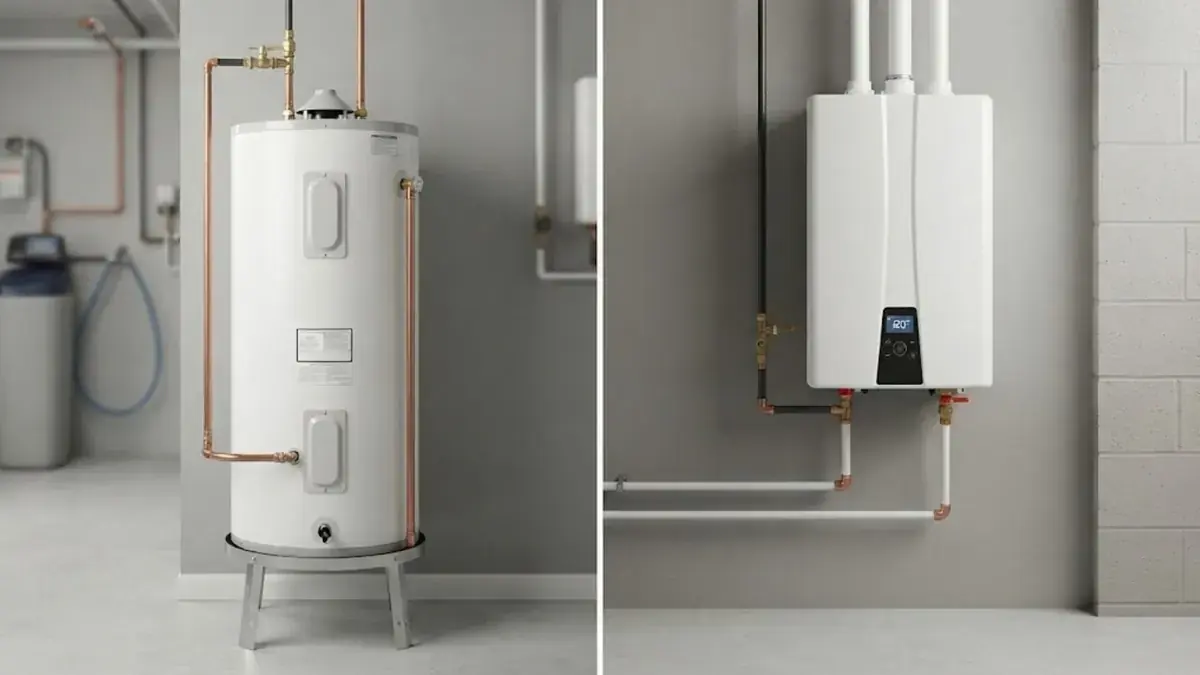
What a hybrid water heater is
A hybrid, or heat pump, water heater pulls heat from the surrounding air and moves it into the water. When demand is high it adds electric resistance heat, which is why the term hybrid applies.
It uses less electricity than a standard electric tank. In exchange it costs more up front, runs a fan, and cools and dehumidifies the room around it.
Hybrid versus standard electric tank
Here is how the two compare.
| Factor | Hybrid heat pump | Standard electric tank |
|---|---|---|
| Upfront cost | Higher | Lower |
| Operating cost | Lower electricity use | Higher electricity use |
| Space needed | Open air space and head room | Small footprint |
| Electrical | 240 volt circuit, sometimes with a condensate drain | 240 volt circuit |
| Noise | Fan hum | Quiet |
| Maintenance | Air filter and condensate drain | Yearly flush |
What the installation adds
A hybrid needs room for airflow, a drain for condensate and often a taller ceiling than a standard tank. The unit is also heavier, which matters in a tight stairwell.
Some installations need a new circuit or a drain line. Ask the plumber to check the room before quoting, because a unit that needs a new drain and a new circuit costs more than one that fits an existing setup.
Basements, floods and where to place the unit
Barberton sits in a valley beside the Tuscarawas River, and June 2019 brought flooding to the city after heavy rain. Many hybrid heaters live in basements, so think about what happens if water rises.
If your basement has flooded, set the unit on a raised stand above the floor and keep its controls well above any past water line. A hybrid also dehumidifies the room, which helps in a damp basement. Check with the building department or Summit County about permits before installation.
Source: City of Barberton press coverage of the 2019 flooding and building department pages.
Hard water and a hybrid
Barberton's latest water quality report lists hardness at 170 mg/L, so a hybrid tank still gets scale in the bottom. A yearly flush and an anode rod check belong in your routine.
A water softener reduces maintenance and protects the unit. Ask about both at the quote visit.
Deciding if it is right for you
A hybrid fits well when you have a large unfinished basement or utility room, high hot water use and electric service. It fits poorly in a closet with no airflow.
Compare it with a standard tank and tankless unit on our water heater installation page. If your current heater has failed, water heater replacement is the faster path. We serve Barberton, Norton and Copley.
Sizing and first-hour rating
Water heaters carry a first-hour rating that tells you how much hot water they deliver in the first hour of heavy use. Match it to your busiest hour, such as a morning with several showers and a dishwasher cycle.
A hybrid unit recovers slowly in heat pump mode and faster in electric mode. A family with heavy peaks may want a larger tank or a higher mode setting.
Operating modes
Most hybrid units offer modes such as efficiency, hybrid, electric only and vacation. Efficiency mode uses only the heat pump and is the cheapest to run but slowest to recover.
Hybrid mode balances speed and savings and suits most homes. Learn the modes at install so you can choose the right one when guests arrive.
Maintenance you should expect
Clean or replace the air filter as the maker directs, flush the tank yearly in hard water and check the condensate drain for clogs. Keep the area around the unit free of clutter so air can flow.
A neglected filter reduces efficiency and strains the compressor. A brief check every few months is enough to keep the unit running well.
Questions to ask before you buy
Ask about the unit's noise rating, the clearance it needs, the condensate drain route, the warranty length and who services it. Ask whether the installer has set up hybrids before.
Also ask how the unit behaves in a cold room. If your basement drops cold in winter, the heat pump may switch to electric mode more often, and that changes the savings.
Ownership costs beyond the price tag
Count the electricity the unit uses, the filter and flush routine and the chance of a repair on a more complex machine. A heat pump water heater has more parts than a simple tank, which adds a few more things that can wear.
Weigh that against lower electric use. A household that uses a lot of hot water gets more back from the efficiency than one that uses little.
Insurance and warranties
Insurance does not usually pay for an upgrade. Read the manufacturer's warranty for what it covers, including labor, and ask the installer how warranty claims work.
Questions readers ask
It uses less electricity than a standard electric tank, though it costs more upfront. Savings depend on use.
They work best in spaces with enough air and moderate temperature. A very cold room reduces efficiency.
It has a fan, so it makes a hum. Placement away from bedrooms helps.
Yes. A raised stand protects it. Keep controls and wiring above past water lines.
It is possible with a 240 volt circuit, but the gas appliance must be removed properly. We check before quoting.
Have a question about your own home? Call (855) 575-2890.