
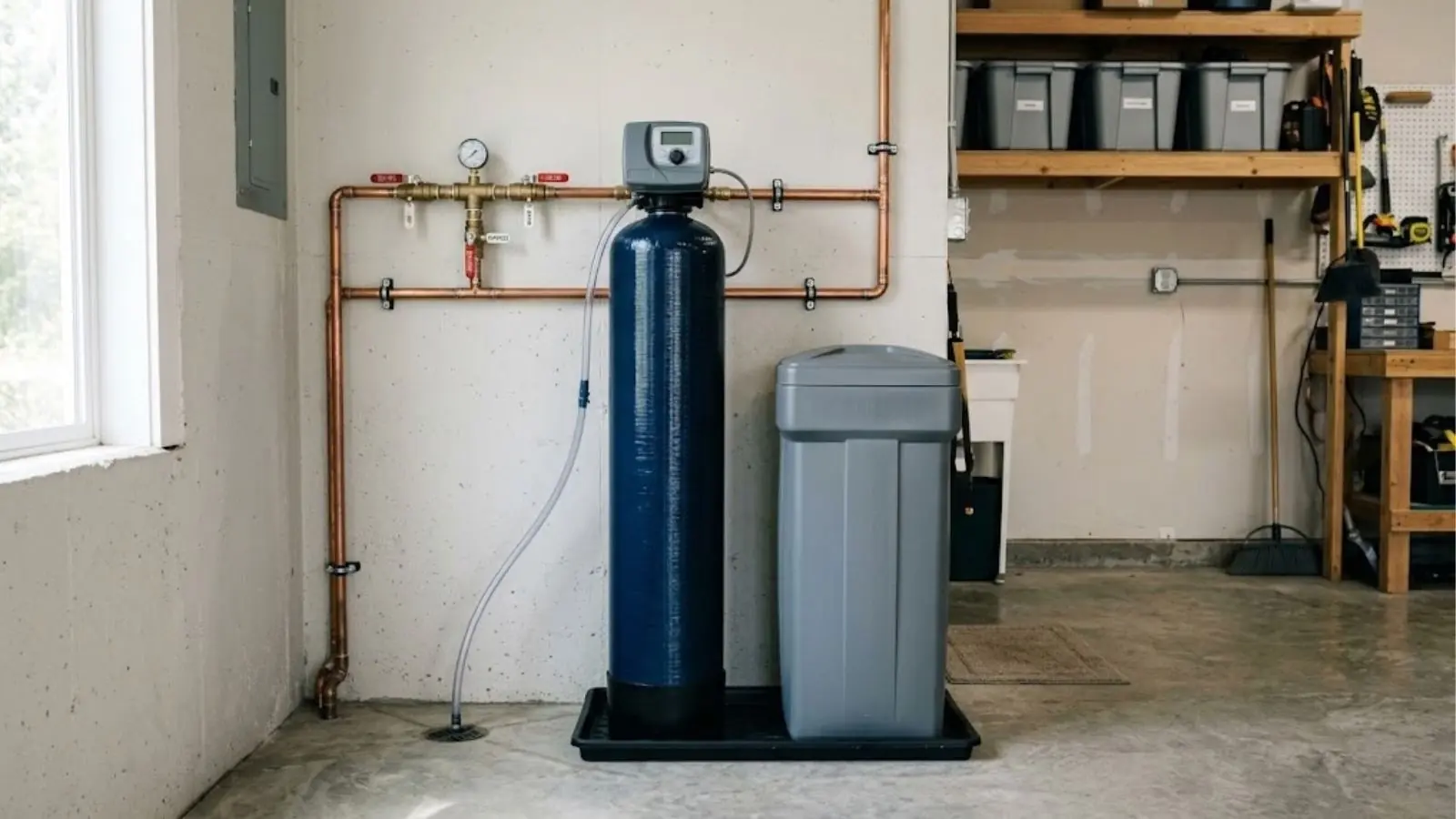
How hard is Barberton's water?
Barberton's latest water quality report lists hardness at about 170 mg/L, with a range of 100 to 250. That works out to roughly 10 grains per gallon, and the US Geological Survey classes 121 to 180 mg/L as hard.
Barberton's water comes from the city reservoir and is treated at the city plant, which also serves parts of Norton and Coventry. The report lists a pH of 7.3. Ask your own supplier or check your bill if you live in Copley, because water sources there vary by address.
Signs hard water is costing you
Hard water leaves a clear trail.
- White crust on faucets and shower heads
- Spotty glasses and dishes after the dishwasher runs
- Soap that does not lather well
- Dry skin or dull laundry
- A water heater that pops or runs long to heat
- Shortened life of appliances that use water
Treatment options
Softening and filtering do different jobs.
| System | What it does | Good for |
|---|---|---|
| Salt-based softener | Exchanges hardness minerals for sodium or potassium | Scale and soap performance |
| Carbon filter | Reduces chlorine taste and odor | Drinking water quality |
| Sediment filter | Catches particles | Rust flakes and silt |
| Reverse osmosis at one tap | Reduces dissolved solids | Drinking and cooking water |
Sizing a softener
Softener size depends on household size and hardness. A family of four with 10-grain water needs a certain capacity per regeneration, and an undersized unit regenerates too often and wastes salt.
We also set the regeneration schedule to your use, and we connect the drain line to a proper air gap. Tell us how many people live in the home and we can size it properly.
What an install looks like
A softener installs in a few hours.
- 1
Locate the main
We pick a spot after the main shutoff and before the water heater.
- 2
Plumb in a bypass
A bypass valve lets you shut off treatment for repairs.
- 3
Connect drain and power
We run the brine and drain lines and plug in the control.
- 4
Program and test
We set hardness, schedule and test the water.
Test your tap first
If you want proof, ask for a hardness test. Summit County Public Health's water quality lab offers drinking water testing, and your water supplier can provide its annual water quality report.
The city's latest report is for the city system as a whole. Your house may differ, so a tap test confirms what a softener must handle.
Keeping a softener working
Check the brine tank once a month and keep the salt level above the water line. Use the salt type the manufacturer recommends, because pellets and block salt behave differently.
Salt can form a hard crust, called a bridge, that leaves the water below it unsalted. If the water turns hard even though the tank looks full, break the crust with a broom handle. We can also set up a yearly visit that checks the resin, the injector and the drain line.
What affects softener pricing
We give a clear price before work starts.
Insurance does not cover softeners. For a quote, call (855) 575-2890.
Ready to treat your water?
Call to schedule a visit and a hardness check.
What to do before we arrive
Check your bypass valve and confirm that the unit has salt. If the softener is leaking, close the bypass and the inlet valve so hard water flows around it.
Note how your water feels and whether spots are new. The tank, the brine line and the drain connection are the first places to look.
Certification to look for
A softener that carries NSF/ANSI Standard 44 certification has been tested for capacity and salt use. Barberton's water is near 170 mg/L, which falls in the hard range, so a softener is a real option for many homes.
What a softener protects
Softened water is easier on heaters. See water heater installation for planning a new tank, and tankless water heater service for the descale schedule. We install softeners in Norton and Copley as well.
Water softener questions
White scale, spotty dishes and soap that does not lather are common signs. A hardness test gives a number.
Usually no. The sodium added is small, and many people notice nothing. Ask about potassium if you are concerned.
It depends on hardness and use. Check the brine tank monthly.
Many people do. If a health condition requires low sodium, ask your doctor and consider a separate drinking tap.
A softener handles hardness, not taste or odor. A carbon filter handles chlorine taste.
Ready to treat your water? Call (855) 575-2890.