
Why price per foot is only part of the story
Copper pipe is sold by the length, and the price follows the copper market, so it moves from month to month. The pipe is only one part of the bill, because every joint needs a fitting, solder and a skilled hand with a torch.
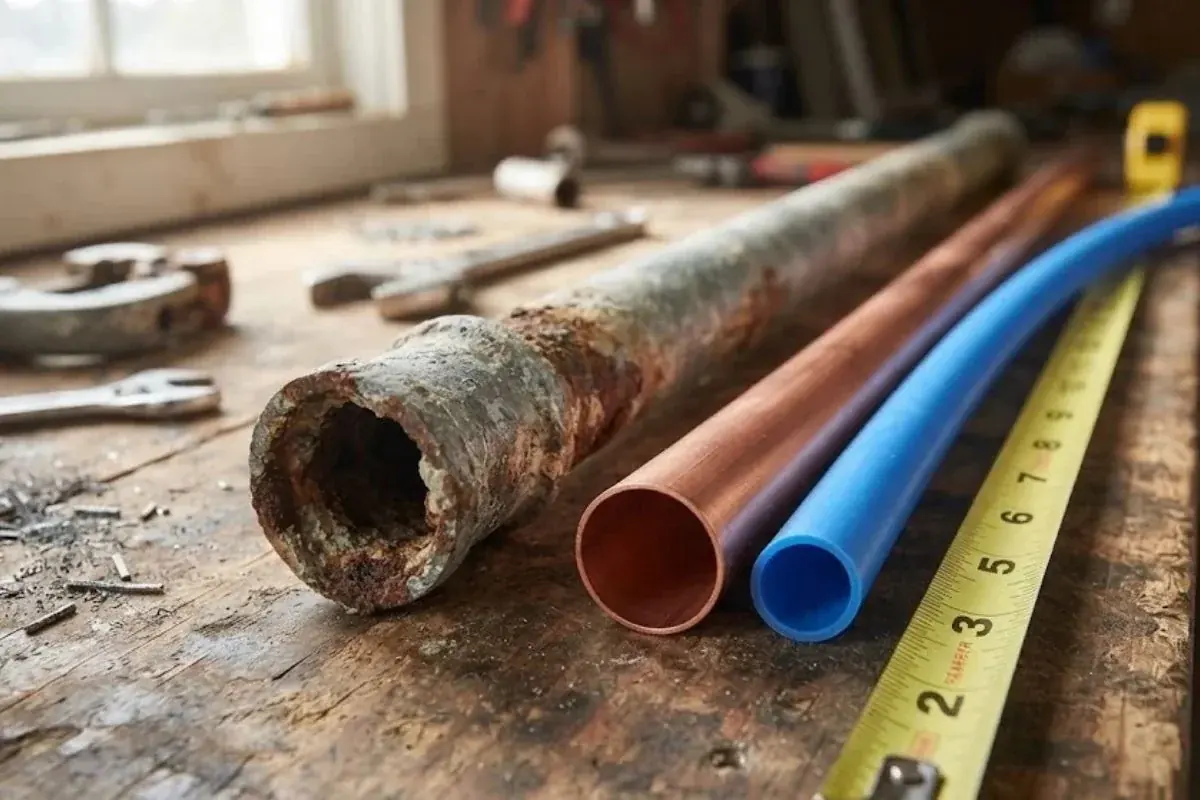
Labor is where copper differs most from PEX. Copper must be cut, cleaned, fluxed and soldered at each joint. PEX uses crimp or expansion fittings and flexible tubing that bends around corners, so it often installs faster.
Copper types and where they are used
Copper pipe comes in thickness grades.
| Type | Wall thickness | Common use |
|---|---|---|
| Type K | Thickest | Underground service lines and heavy duty |
| Type L | Medium | Interior supply lines in most homes |
| Type M | Thinner | Interior supply where code allows |
Thicker walls cost more per foot. Check what your local code allows before choosing a grade.
What changes the total cost
The number of fixtures, the length of runs and how many walls must be opened are the big drivers. A house with a basement and open joists is cheaper to pipe than one with plaster walls and finished ceilings.
Fittings add up too. Elbows, tees, valves and unions each cost more than a straight length, so a complicated layout costs more than a straight run of the same length.
Does Barberton's water suit copper?
Barberton's latest drinking water results list a pH of 7.30 and a copper 90th percentile of 0.2965 parts per million, well below the 1.3 parts per million action level. That is a utility-wide result, not a guarantee for any one house.
Hardness is about 170 mg/L, so scale will form in any metal pipe over the years. Copper handles that well when installed correctly, and a water heater flush plus a water softener reduce the scale load.
Source: City of Barberton consumer confidence report.
When PEX makes more sense
PEX resists freeze splitting better than rigid pipe and installs faster, so a full house repipe can cost less. Copper has a longer track record and handles higher temperatures near heat sources.
Many plumbers mix the two: copper at the water heater and in exposed runs, PEX in the walls. Ask for both options in writing so you compare like with like. Our repiping page explains how a full replacement works.
Planning for pinhole leaks
If your copper lines have started to pinhole, the cause may be local corrosion, high water velocity or a poorly made joint. One pinhole may be a repair, while several in a year suggest a section is failing.
Find out where the leaks start with leak detection, then decide whether to patch or replace. A burst section needs fast action, and burst pipe repair covers the first steps.
Soldering, fittings and code
Modern copper joints use lead-free solder, and fittings must meet the plumbing code. Poor soldering leads to pinhole leaks and weeping joints years later, so craftsmanship matters more than the price per foot.
Ask whether the plumber uses press fittings, which join copper without a torch. They cost more per fitting but can speed the job and avoid open flame near framing.
Copper compared with other materials over time
PEX and CPVC cost less to install, and copper costs more but has a long record in homes. Each has failure modes: copper can pinhole in aggressive water, PEX can fail at poor fittings and CPVC can turn brittle with age.
Choose by your house, your water and your budget. The cheapest option today is not always the cheapest over twenty years.
How to compare quotes fairly
Ask each plumber to list the pipe grade, the fitting type, the number of fixtures served, the permit fee and who patches the walls. A low quote that excludes wall repair may cost more in the end.
Request a written scope with a start date and a completion estimate. A clear scope is a good sign of a careful contractor.
What to expect during the job
A copper repipe is loud, dusty and takes planning. The crew shuts off water, cuts out old lines, runs new pipe and tests under pressure. Expect water to be off for part of each day and walls to be opened where the route requires it.
Ask how the crew protects floors and furniture, and who patches the drywall. A clear plan for cleanup is part of a fair price.
Recycling and old pipe
Old copper has scrap value, and some plumbers credit it against the job. Ask whether the quote accounts for it. Old galvanized steel has no such value and goes to the dumpster.
Pipe standards behind the price
Copper tube is sold in types K, L and M under ASTM B88, and the wall thickness explains much of the price gap between them. The Ohio Plumbing Code, built on the International Plumbing Code (IPC), decides which type is allowed where.
Getting a fair quote
Ask for the pipe grade, the fitting type, the permit fee and the wall restoration scope. Compare totals, not per-foot prices.
We quote repipes in Barberton, Norton and Copley after a walkthrough, and we tell you when a partial repipe will do.
Questions readers ask
Material and labor both tend to cost more for copper, though prices change and each house differs.
Copper often lasts for decades when water chemistry and installation are good. Pinhole leaks signal trouble.
Yes, with proper transition fittings.
The city's latest results show copper well below the action level, but results reflect the utility and not a specific home. Test your tap if you are concerned.
Often, yes. Ask the Barberton building department or Summit County, and we confirm on each job.
Have a question about your own home? Call (855) 575-2890.